A top Google executive made clear at a Wednesday hearing that the tech giant was proud of its censorship record. This admission may have dire implications for Big Tech’s ability to censor without consequences.
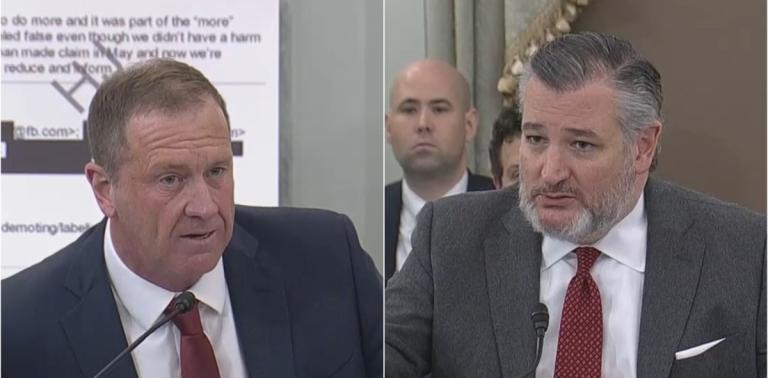
Markham Erickson, a government affairs executive at Google, repeatedly stated at a Senate Commerce, Science and Transportation hearing that though the Biden administration had pressured Google to censor, the search giant had ultimately acted independently. Erickson also emphasized that Google had not admitted wrongdoing or made changes despite settling President Donald Trump’s lawsuit against the company for censoring him in 2021.
Ultimately, Erickson did not blame the third-party actors for the rampant censorship, but said, "No matter how the information comes to us, we feel a responsibility and are proud of the way we handle those communications to make independent decisions." [Emphasis added].
Google’s censorship campaign is not in the rear-view window. According to the tech giant’s transparency report covering April 2025 to July 2025, YouTube took down 121,698 videos and 66,096 channels for so-called “misinformation.” These massive figures do not account for the other categories of videos and channels removed.
In response to the Google witness’s heinous answers, Sen. Bernie Moreno (R-OH) warned Erickson and fellow witness and Meta VP of Public Policy Neil Potts that Big Tech companies might be “on the road to hell now.” Moreno let Big Tech know that by silencing legal speech, they become publishers who risk being held accountable for all speech that remains on their platform.
Moreno challenged Google and Meta to embrace free speech and avoid the pitfall of losing liability protection: “Why not just completely get out of the censorship business unless it's the clear things that Senator Blackburn talked about, human trafficking, child trafficking, incitement? Why not get out of the censorship industrial world and just say we're just going to be a platform to allow free expression?”
In an exclusive statement to MRC Free Speech America, Sen. Eric Schmitt (R-MO) agreed that Google was behaving like a publisher and laid down the law against Google’s conduct.
“The whole underlying rationale for Section 230 protection was that you’re gonna be an open platform, that you’re not a publisher, you’re not making those kinds of editorial decisions, right?” Schmitt explained. “So if they’ve moved into politically-biased territory—which I think you can accurately prove—of course, they will lose Section 230 protections.”
Schmitt went on to mention that he has introduced legislation that would strip Section 230 protections from companies that are “connected with the federal government on the outsourcing of censorship.”
He followed this by echoing Moreno’s call for the platforms to take a better path, saying, “I want these platforms to be open platforms. I think that’s actually a good thing, to have an open dialogue. But I think they’ve proven, time and time again, especially Google, that they’re politically biased in their search.”
During the hearing, Cruz also went after Google, pressing Erickson on his defense of Google censorship. “It is Google's position that you regret nothing. Is that right?" Cruz asked.
At another point, Cruz stated that Erickson’s complete lack of contrition suggests a “level of contempt for free speech that does not reflect well, and it may be why Google abandoned its old motto of don't be evil."
Outrageously, Erickson touted Google’s censorship of so-called hate speech and asserted that Google had censored independently in his opening statement, listing “hate speech” among the content that he said has “no place on our platforms.” He also expressed no remorse for censoring election content on YouTube, defending it in the context of the moment.
MRC Free Speech America Director Michael Morris read between the lines, “In other words, Google will continue to censor. The tech giant is suggesting here that it is the arbiter of truth, that it and it alone determines what information can be and cannot be viewed by the end user of its platforms. It’s acting like a publisher in this regard. Publishers, unlike platforms, do not get Section 230 liability protections. If Google wants to act like a publisher, then it can’t also have its cake and eat it too.”
ICYMI: MRC Free Speech America VP Dan Schneider Tears Apart YouTube Letter
Conservatives are under attack! Contact your representatives and demand that Big Tech be held to account to mirror the First Amendment while providing transparency, clarity on hate speech and equal footing for conservatives. If you have been censored, contact us using CensorTrack’s contact form, and help us hold Big Tech accountable.