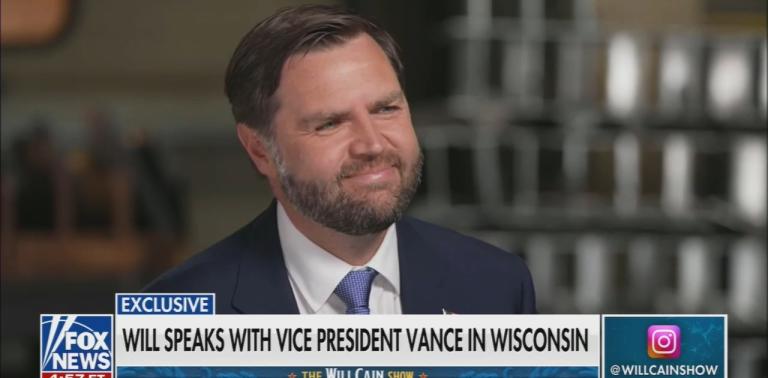
Vice President JD Vance said Thursday that the West became “too comfortable with censorship” and explained the rationale behind his staunch defense of free speech during a series of remarks in Europe.
In an interview with Fox News host Will Cain, Vance said his speeches were fueled by his desire to stop censorship overseas, warning that such measures will eventually spread to the United States and vice versa.
“I think in some ways the problems of Europe mirror the problems of America. And anything that I’ve said about Europe, I've said ten times and is even as true or more true in the United States of America,” Vance said when asked why he chose to focus on Europe.
He also drew parallels between censorship efforts in Europe and the U.S., stating: “[I]n the same way the Biden administration went after social media companies to censor their fellow citizens, you see the very same thing happening in Europe, where rather than debate ideas, you have certain European leaders who would rather censor their fellow citizens.”
In essence, Vance warned that anything that happens in Europe can and will impact America. “I think it's important for us to step back and say, ‘Look, the West, right— that's Europe and America together—we got too comfortable with open borders, we got too comfortable with censorship,’ and I think the president has shown that if you go the other direction, if you close down your borders and actually give free speech to your people, you can really energize the culture in these countries.”
Vance’s stance echoed earlier remarks delivered abroad. Just weeks after being sworn into office, Vance declared that the U.S. would not be “co-opted into a tool of authoritarian censorship” while speaking at the AI Action Summit in France.
He repeated this warning just three days later at the Munich Security Conference in Germany: "The threat I worry the most about vis-à-vis Europe is not Russia, it's not China, it's not any other external actor. And what I worry about is the threat from within, the retreat of Europe from some of its most fundamental values, values shared with the United States of America.”
Flashback: Vice President Vance Blasts EU Censorship at Munich
Vance raised this issue again earlier this month, calling out censorship during a meeting with British Foreign Secretary David Lammy on Aug. 8.
"I think the entire collective West, the transatlantic relationship, our NATO allies, certainly the United States under the Biden administration, got a little too comfortable with censoring rather than engaging with a diverse array of opinions,” he said. “So that's been my view. … But the thing that I'd say to the people of England or anybody else, to David, is many of the things that I worry most about were happening in the United States from 2020 to 2024.”
He added, “I just don't want other countries to follow us down what I think was a very dark path under the Biden administration.”
Vance’s concerns were not unfounded. The Media Research Center revealed that the Biden administration implemented at least 57 censorship initiatives across 90 government agencies. These included shutting down COVID-19 criticism, pressuring Big Tech companies to silence dissent and manipulating the development of AI to promote a leftist agenda, among other actions.
Europe, not to be outdone by the Biden administration, has heralded the passage of controversial censorship laws, such as the European Union’s Digital Service Act (DSA) and the UK’s Online Safety Act. In the UK, as many as 30 people face daily arrests for the petty offenses of reposting or sharing memes.
President Donald Trump has prioritized fighting these global censorship laws, threatening to impose sanctions on individuals or countries that try to coerce American social media companies to censor content.