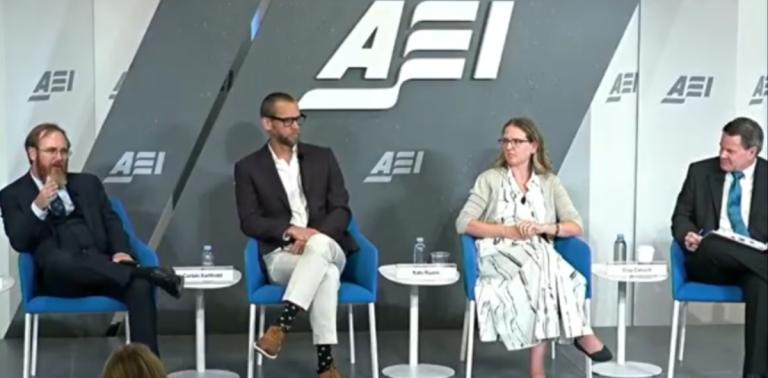
A panel at the American Enterprise Institute turned into a Big Tech lovefest, with the panelists advocating that social media companies have the right to censor Americans.
Kate Ruane, a director at the Center for Democracy and Technology, and Corbin Barthold, a TikTok U.S. Content Advisory Council member, expressed their disdain for free speech in response to an audience question about whether Big Tech platforms should be considered "common carriers." This classification would require social media platforms to host all users' content to receive liability protections under Section 230 of the Communications Decency Act of 1996.
“I don’t know if I could think of a better way to exacerbate the problem, in my mind,” Barthold told the audience during the "Free Speech and Tech Policy at the US Supreme Court, 2025" panel Wednesday. He added that requiring platforms to allow free speech would transform them into “sewage pipes similar to Gab.” Earlier, Barthold had called “the whole censorship of conservatives thing being overblown about social media” and bitterly complained about free speech and antitrust victories against advertiser collusion.
Ruane, for her part, agreed with Barthold. In a long-winded response—where she used the phrase “content moderation,” a favorite among leftists as a euphemism for censorship—Ruane claimed that she preferred platforms not to allow or be required to allow free speech:
“I share Corbin’s concerns that the creation of a kind of must-carry obligation for large social media platforms would be a, you know, a sort of avenue by which content moderation could actually be subject to even more jawboning by motivated actors that want to force certain speech to stay up, where human rights assessments might counsel that they be taken down, umm, or otherwise restricted in their distribution in order to ensure that everybody is able to participate in online platforms that are, you know, generally applicable.”
After attempting to portray censorship benignly, Ruane went on to point to the anti-free speech, liberal haven Bluesky platform as a model for other platforms due to its customization tools. Ruane left out the fact that while Bluesky does allow users to tailor their own feeds to their liking, it only does so in addition to intense censorship conducted by the platform itself.
In response to the panel’s comments, MRC Free Speech America VP Dan Schneider explained that the panelists appear to be advocating for Big Tech companies to have the right to discriminate like publishers, while still claiming Section 230 liability protections.
“Big Tech companies are arguing that they have a constitutional right to discriminate against anyone, for any reason,” said Schneider. “They are trying to resurrect a worse version of the Plessy v. Ferguson standard. They want the right to deny speech based on a person’s race, their religion, their sex or their political viewpoint. And that’s precisely what they are doing today.”
Schneider then gave examples of how Big Tech companies, like Meta and even ride share companies like Uber and Lyft, have discriminated through censorship recently. “Facebook took down the page of a religious organization, specifically because it was religious,” said Schneider. “And rideshare companies have even argued before the U.S. Supreme Court that they can deny service to black people based on their race.””
Earlier in the event, Ruane responded to a different U.S. Supreme Court case, Free Speech Coalition v. Paxton, which would require sites that host sexually explicit material to use age verification tools to access the sites.
First, Ruane complained to the AEI audience that laws restricting “sexual content” for minors might be expanded to shield them from content related to “gay relationships or the existence of ‘trans’ people.”
Ruane then followed her claim by bringing out the well-worn progressive warning that everything affects LGBTQ+ and minorities more. She claimed that errors in verifying who is an adult will particularly impact “adults in marginalized populations … particularly adults, adults in, like adults with disabilities, adults who are LGBTQ, particular, particularly ‘trans’ and ‘nonbinary’ people and adults of color.” She added, “They are more likely to experience error rates in a lot of these age verification methods.”
To be clear, Ruane was trying to win over an AEI audience, not the notoriously leftist Human Rights Campaign, Antifa, the Democratic Socialists of America or her Soros-funded employer, the Center for Democracy & Technology. In addition to the Wikimedia Foundation, Ruane also previously worked at the American Civil Liberties Union and was introduced as a person who specializes in legislative restrictions on things like “book bans” (which, in leftist speak, typically means prohibitions on taxpayer-funded schools sharing LGBTQ propaganda and pornography with young children). Ruane also spoke out against attempts to shield children from drag performances in Tennessee during her time at Soros-funded PEN America.
In fact, one of the panelists actually acknowledged how far this panel had drifted from the founding principles of AEI. Barthold remarked that the predecessors of AEI, such as Irving Kristol, would be “appalled” by “our position in Paxton.” Neither the moderator nor any of the panelists disputed that they agreed with Barthold’s position against age verification for pornography. This observation about AEI’s place on the political spectrum made the moderator, AEI Nonresident Senior Fellow Clay Calvert, laugh.
Conservatives are under attack! Contact your representatives and demand that Big Tech be held to account to mirror the First Amendment while providing transparency, clarity on hate speech and equal footing for conservatives. If you have been censored, contact us using CensorTrack’s contact form, and help us hold Big Tech accountable.