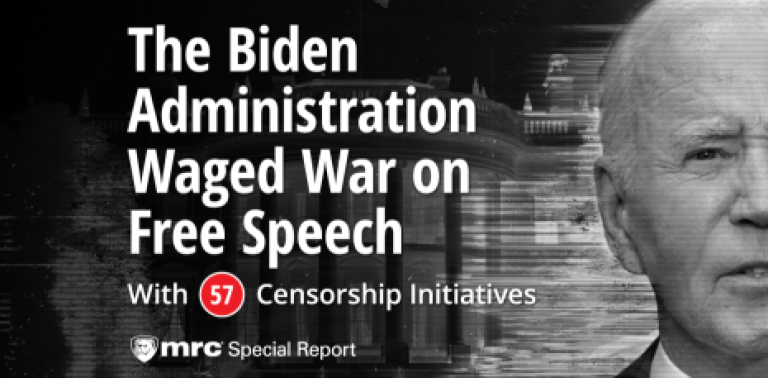
The following article is a supplement to the MRC Report: The Biden Administration Waged War on Free Speech with 57 Censorship Initiatives.
Initiative #48: The Perversion of Sec. 230
Type of Censorship: Policy or rulemaking
Agencies Involved:
- Federal Communications Commission (FCC)
Summary:
President Joe Biden and his Federal Communications Commission (FCC) acted to transform a law that protected free speech into a law that assaulted it.
Under the Communications Act, digital services fall into two categories: Title II common carriers or 47 U.S.C. § 230 (Section 230) online information services. Title II common carriers are forbidden from censoring. Section 230’s text states that an online information service is generally not liable as a publisher for the content third parties upload, and does not become a publisher so long as it limits its removal of content to an enumerated list of categorical justifications. However, this definition has been muddied by activist lower court judges who have suggested that Section 230-protected platforms (but not Title II common carriers) can censor with impunity.
In May 2020, President Donald Trump issued Executive Order 13925, the “Executive Order on Preventing Online Censorship.” This order directed the FCC to issue administrative rulemaking clarifying the original meaning of 47 U.S.C. § 230 (Section 230). Under the Administrative Procedures Act, the FCC then issued a notice of proposed rulemaking to publish a clarification stating tech platforms could not claim Section 230 protections when they were discriminating on the basis of viewpoint.
Biden rescinded Order 13925. This rescission did not obligate the FCC to halt its rulemaking authority, but under the leadership of Biden-appointed chair Jessica Rosenworcel, the agency did just that.
Instead, the Biden/Rosenworcel FCC voted to impose Title II requirements on internet service providers (ISPs). The FCC claimed in its order this was necessary to prevent ISPs from throttling content the companies disliked — a premise based on the atextual notion that if ISPs were Section 230-protected, they would have a legal right to censor.
The FCC’s ISP order then refused to apply its Title II common carrier rules on email inboxes and web hosters. By claiming Title II was the only way to prevent censorship, and then making the bizarre and incongruous choice to exempt firms like Amazon, Apple and Google from Title II requirements, the FCC was de facto blessing Big Tech censorship.
Key Individuals:
- Joe Biden, President of the United States
- Anna Gomez, FCC Commissioner
- Ron Klain, White House Chief of Staff
- Jessica Rosenworcel, FCC Chair
- Geoffrey Starks, FCC Commissioner