The Supreme Court just protected Americans from being subjected to more censorship from a Biden censorship regime that they didn’t vote for.
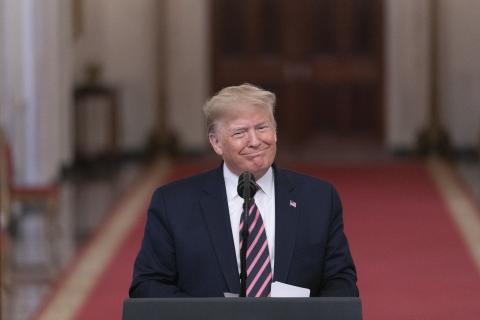
On Monday, the Supreme Court ruled 6-3 in Trump v. Slaughter that the president has broad authority to fire members of executive branch committees at-will. This decision has implications for past and future victories related to free speech. The ruling enhances presidential control over executive agencies, including those engaged in censorship, as highlighted in the Media Research Center's report on Biden's 57 censorship initiatives.
President Donald Trump has been able to make significant strides in reversing Biden-era censorship by removing officials who targeted Americans' free speech online. Agencies and departments that have experienced notable reductions include the Cybersecurity and Infrastructure Security Agency (CISA), the Department of Health and Human Services, and the National Science Board.
CISA, in particular, was heavily involved in orchestrating censorship through its Election Integrity Partnership, which reportedly worked with social media companies to flag content to be censored. Twitter Files journalist Michael Shellenberger even called CISA “the center of gravity for much of the censorship” during a November 2023 hearing.
These dismissals will remain in place, and future efforts to end Biden-era censorship via personnel termination will be allowed thanks to the Supreme Court’s decision in Slaughter.
Chief Justice John Roberts delivered the opinion for the Slaughter case, joined by Justices Samuel Alito, Neil Gorsuch, Brett Kavanaugh, Amy Coney Barrett and Clarence Thomas, who dissented in part. The court’s decision reaffirmed the separation of powers established in Article II of the U.S., which grants sole executive power to the president.
The case originates with the plaintiff Rebecca Slaughter, who was originally nominated as a Federal Trade Commissioner by Trump during his first presidential term and was renominated in 2023 by President Biden. During his current term, Trump notified Slaughter of her immediate termination, after which she brought suit in federal court in D.C. At the trial court, Judge Loren L. AliKhan ordered Slaughter’s reinstatement, but the Supreme Court granted the Trump administration’s request to hold the ruling while the case was appealed.
Roberts said that because the FTC “unquestionably exercises executive power” it must be within the direct authority of the president. It has long been clear, Roberts said, that those within the president’s control “must be removable by the President at will.”