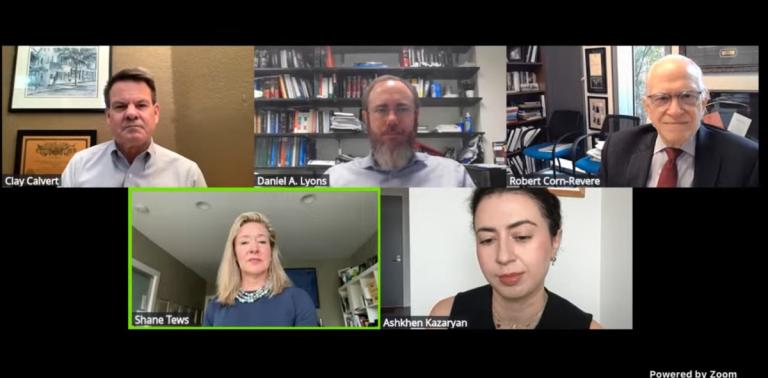
A Washington, D.C.-based think tank attacked free speech, FCC Chair Brendan Carr and the Trump administration at a panel largely indistinguishable from the ideological diversity you’d see on an MSNBC segment.
An Oct. 8 American Enterprise Institute (AEI) panel repeatedly defended “the free speech rights of platforms,” or, as freedom-loving Americans like to say, Big Tech assaults on free speech. AEI panelists also bashed Carr and the Trump administration over several cases involving the use of public airwaves to engage in election interference, to spread false claims, or to broadcast the location of ICE agents. In their broad assault on Carr and online free speech, panelists even praised one of his predecessors for refusing to use Section 230 to defend the speech rights of social media users.
Why would a purportedly conservative think tank’s panelists defend Big Tech so fiercely? Several news outlets have reported that AEI has received funding from Big Tech companies such as Google, Meta and Amazon. Additionally, AEI has taken in almost $10 million from Microsoft Founder and CEO Bill Gates’s foundation since 2007.
During the event, several panelists made excuses for Big Tech censorship, fiercely opposing efforts to hold platforms accountable.
AEI nonresident senior fellow Daniel Lyons commended former FCC Chair Michael O’Rielly for going against President Donald Trump on Section 230. Lyons claimed that, unlike Carr, O’Rielly “stuck to his principles even though it meant having to step away from the reins of power.”
Ashken Kazaryan, a former “content regulation” lead at Meta, also lauded the former FCC chair. Kazaryan held this censorship role for North and Latin America from 2020 to 2022, years of incredible censorship that even included the silencing of Trump. Tellingly, the panel moderator and AEI nonresident senior fellow Clay Calvert offered zero pushback despite several opportunities to do so.
For instance, when Kazaryan addressed government pressure on Meta to censor, she never acknowledged her own role or distanced herself from the company's censorship efforts. Instead, she suggested that both political parties were anti-free speech.
Additionally, Lyons defended social media platforms’ purported right to censor during remarks on the Supreme Court case Murthy v. Missouri. He suggested that platforms might or might not have been censoring due to pressure from the Biden administration. Instead, he posited that they might just have been enforcing their “misinformation” policies, “In a way that's in accordance with their own First Amendment right of editorial control over their speech platform.”
Panelists Bash Carr FCC, Trump Administration
Despite the anti-free speech comments and backgrounds of many panel members, each was hypersensitive to the supposed transgressions of Carr.
The whole panel was united against the Trump administration's actions to enforce the “Public Interest Standard” or the duty broadcasters utilizing public airwaves have to serve the public interest, which was imposed by the Radio Act of 1927 and the Communications Act of 1934.
But MRC Free Speech America VP Dan Schneider took a stand against using public airwaves to distort the news for partisan gain. Schneider wrote in an October 11 column for The Hill, “Broadcast television is fundamentally different from cable, streaming or podcasting. Local affiliates of ABC, NBC and CBS operate on publicly owned frequencies, granted free of charge by the FCC. This is no small privilege — it is a massive public subsidy, akin to the taxpayer funding that supported NPR and PBS.”
Schneider went on to explain how Carr provided local stations the clarity and confidence to push back against networks that have consistently pressured them to run liberal content. “Highlighting this imbalance isn’t a call for conservative programming or partisan retaliation,” wrote Schneider. “It is a reminder of the deal these broadcasters made: free use of a public resource in exchange for serving the full American public — not just a favored slice.”
Despite such important distinctions, the panelists inveighed against Carr for calling out comedian Jimmy Kimmel for a blatant case of news distortion, which Kimmel engaged in while speaking for a broadcaster with a near-monopolistic grip on limited federally owned spectrum.
Robert Corn-Revere, another panelist and the chief counsel at the Foundation for Individual Rights and Expression, was no exception. Corn-Revere co-authored a piece defending Big Tech censorship and his organization’s attempt to persuade the Supreme Court to rule against free speech with the brazen headline “FIRE to Supreme Court: Only you can protect free speech online.”
Nevertheless, Corn-Revere chose to pontificate about Carr’s supposed wrongs, referring to the Public Interest Standard as a “relic of the past that has been dusted off and used for jawboning purposes.”
However, when it came to specific cases, Corn-Revere went even further. He argued that when 60 Minutes shamelessly edited in defense of then-Vice President Kamala Harris’s presidential campaign, it did not amount to distortion:
“So, for example, you had the news distortion complaint against 60 Minutes for its interview with Kamala Harris prior to the the 2024 election. And by the way, as bogus as a complaint as I've ever seen. Essentially, the CBS, Bill Whitaker, on 60 Minutes, asked Kamala Harris a question about the response by Israel's government, and she gave an 80-word answer, half of which was done as a promo on Meet the Press, half of which was done on 60 Minutes. It wasn't distortion in any, in any sense and should have been promptly dismissed upon filing.”
For reference, 60 Minutes aired a promo that included a word salad answer from Harris on the conflict between Israel and Hamas terrorists. But when the interview came out, Harris had an entirely different and more concise answer to the question, which even contained an olive branch to disaffected anti-Israel Democrats.
Corn-Revere was not alone, however. The other panelists also went after Carr. Kazaryan warned FCC and FTC employees that they were destroying democracy, leading Calvert to commend her wild claim as a “great way to close this conversation.” Meanwhile, Lyons claimed that Carr had used “New Jersey mob language” in his criticisms of Kimmel.
The AEI attack against Carr appears to be part of a broader effort to protect leftist media coverage buttressed by public resources. From public airwaves to which ABC, NBC and CBS have been given special access, to the funding recently stripped from PBS and NPR, infamously biased and partisan coverage has gotten a boost from Uncle Sam.
Conservatives are under attack! Contact your representatives and demand that Big Tech be held to account to mirror the First Amendment while providing transparency, clarity on hate speech and equal footing for conservatives. If you have been censored, contact us using CensorTrack’s contact form, and help us hold Big Tech accountable.