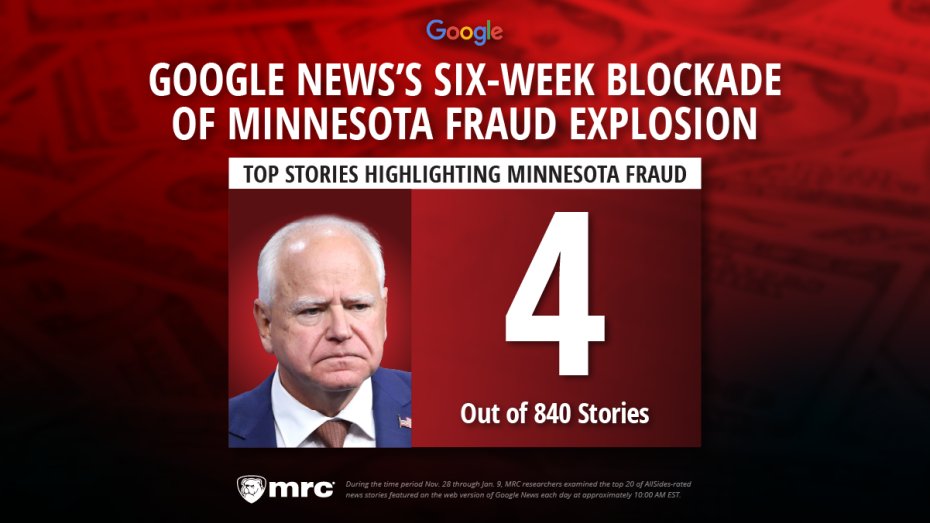
Google News, a digital gatekeeper that shapes what millions of Americans see each day, kept its readers in the dark as the Minnesota fraud scandal intensified, publishing just four stories on the matter out of 840 in its top 20 morning editions from Nov. 28 to Jan. 9.
The scandal gained national attention in November amid reporting that a group of Somali Americans exploited a COVID-19 relief program and later became linked to broader child care fraud allegations in Minnesota.
Google News’s near blackout of the Minnesota fraud scandal is stunning, given its magnitude and political consequences, especially after Walz abruptly suspended his re-election campaign despite repeatedly signaling his intention to seek a third term.
MRC’s Findings:
- Google News featured only four stories on the Minnesota fraud scandal out of 840 stories it published in its morning edition over six weeks.
- None of the four stories came from a right-leaning outlet, and three of them actively sought to vilify Trump administration enforcement actions.
- Google News buried the news even when it shared it:
- Google News waited four days after a New York Times exposé on the Minnesota fraud scandal before finally publishing a Dec. 3 anti-Trump CNN story buried on a live update page. Google News outrageously published two other stories on days that typically rank among the lowest of the year for news viewership and ratings (Dec. 30 and Jan. 1).
The Data Explained: MRC reviewed 840 stories published by Google News in its top 20 placements from Nov. 28 to Jan. 9, a span of six weeks, or 42 days. Of those stories, only four addressed the Minnesota fraud scandal.
One such story featured by Google News came from CNN, though it was not even a standalone report but a live-update page that buried earlier reports as new information came throughout the day. As a result, the first mention of the fraud scandal is 15 entries deep at the time of this analysis. Other posts in the live update fixated on immigration operations while largely concealing the fraud allegations that had prompted the federal response.
Another featured story came from The Hill on Dec. 30, which reported that the Trump administration froze child care payments.
The other came from the Minnesota Star Tribune on Jan. 1, which sought to minimize the accusations raised in a viral video under the headline, “We went to the day cares Nick Shirley did. Here’s what we found.”
The Star Tribune did not treat the child care controversy as a fraud investigation. Instead, it took a sentiment approach, reframing the story around emotional distress and community fear, instead placing sympathy with the operators while attempting to minimize the broader context of Minnesota’s massive fraud scandal.
According to media bias ratings firm AllSides, The Hill is rated center and the Star Tribune is rated left-leaning.
Google News did finally push a fourth story on the fraud scandal, this one from left-leaning Axios. The Axios report uncritically echoed the talking points of five Democratic attorney general who claimed the child care funding freeze was political punishment rather than a response to mounting fraud concerns. The piece framed the lawsuit’s partisan narrative as fact while minimizing the corruption allegations that triggered the federal action in the first place.
MRC conducted this review by examining the top 20 stories featured by Google News at approximately 10:00 a.m. each day.
What Google News Censored: For weeks, the Minnesota fraud scandal produced a steady stream of major developments with serious legal and political consequences. Despite the frequency of these events, Google News repeatedly failed to reflect them in its coverage.
The censored developments analyzed included:
- Nov. 28: The Department of Justice’s announcement of the 78th arrest in the sweeping pandemic fraud investigation.
- Nov. 29: A New York Times story that gave the scandal renewed national attention.
- Dec. 1: The re-release of audio recordings appearing to unveil Minnesota Attorney General Keith Ellison vowing to protect figures tied to the fraud scandal.
- Dec. 3: The House Oversight and Government Reform Committee’s launch of a formal investigation into the scandal.
- Dec. 12: The Treasury Department’s investigation into financial aspects of the fraud scandal, tracking suspicious money flows linked to the scheme.
- Dec. 26: The viral video of independent journalist Nick Shirley sounding the alarm about child-care fraud, a scandal separate from the pandemic fraud allegations.
- Dec. 28: The FBI’s explanation of its investigation of the fraud scheme.
- Jan. 6: The federal deployment of more than 2,000 federal agents in Minneapolis, more than double the size of the local police, in response to fraud allegations.
- Jan. 7: The House Oversight Committee’s first high-profile hearing on the fraud scandal.
Taken together, these developments formed a steady escalation of the Minnesota fraud crisis over a six-week period.
Methodology: During the time period Nov. 28 through Jan. 9, MRC researchers examined the top 20 of AllSides-rated news stories featured on the web version of Google News each day at approximately 10:00 AM ET. MRC researchers used the AllSides media bias ratings, which categorize an outlet as “left,” “lean left,” “center,” “lean right” or “right” to determine the overall bias presented by Google News and analyzed the results. MRC researchers then manually reviewed the articles to determine whether they specifically addressed the Minnesota fraud allegations.