After President Donald Trump's 2024 victory appeared inevitable, tech giants rushed to project a friendlier posture toward him. But behind the scenes, their election meddling continued, most recently surfacing in Republican primaries in the lead-up to the 2026 midterms.
Apple News, Google News, Microsoft's MSN, and Yahoo News are at the center of the latest election interference. These aggregators, collectively known as the Big Four News Apps, have re-framed Trump’s victories in GOP primaries as part of a “retribution campaign” rather than explaining the frustration Republican voters have toward those who would buck the President’s leadership.
The negative framing, including gratuitous attacks on Trump and his endorsed candidates, is more of the same. MRC studies have shown how the tech giants have interfered in elections since at least 2008, always in favor of the most liberal candidate they determined could win.
Over the first 100 days of GOP primaries, the Silicon Valley tech giants force-fed biased content and smears about Trump and Republican candidates, including Ken Paxton, Steve Hilton, Ed Gallrein and others, from left-leaning outlets that are reliably doing the bidding of the Democratic Party. As a result, Americans were consistently presented with coverage that portrayed Trump as a villain and his preferred candidates as extremists, while alternative perspectives were largely silenced.
MRC’s Findings:
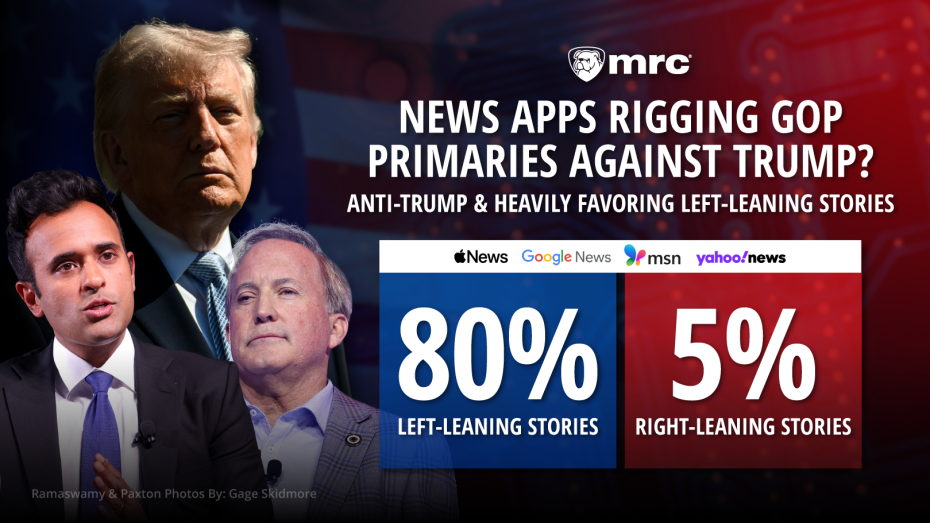
- The Big Four News Apps negatively characterized Trump, his endorsed candidates, and even their ultimate victories. Out of at least 155 stories published about the GOP primaries and Trump-backed candidates, 124 stories (80%) were sourced from left-leaning media outlets with reliably hostile coverage, while only eight stories (5%) came from AllSides-rated right-leaning counterparts. Additionally, just 21 stories (13%) were from AllSides-rated centrist outlets.
- Over the first 100 days, the Big Four News Apps were more biased in favor of the left's perspective in news stories they specifically promoted about the elections than they were across the overall breadth of news stories they shared during the period.
- Dozens of the stories directly portray Republican primary wins as defeats and Trump’s influence as toxic revenge. Success was re-cast as a loss for the incumbent or as a problem for the GOP.
- Conversely, the Big Four News Apps excluded the bulk of right-leaning coverage that provided a more balanced perspective of the Trump-backed candidates and the issues driving their campaigns. MRC researchers found no fewer than 20 relevant stories from right-leaning media outlets that were silenced by the tech giants. Among the excluded right-leaning sources were the Washington Examiner, Just the News, The Federalist and The Christian Broadcasting Network, just to name a few.
“A rational person might think that Apple, Google, MSN, and Yahoo would want the perspective of right-leaning outlets for stories about Republican primaries,” said MRC Vice President for Free Speech Dan Schneider in response to these findings. “It’s pretty obvious that the New York Post, The Dallas Express and The Telegraph would have a better understanding of Republican voters than any of the leftist reporters do at NPR, The New York Times or The Guardian. But those elitist media outlets replaced ‘news’ coverage with political spin a long time ago. That’s why the radicals at Apple and Google rely on them so much.”
How the Big Four News Apps Pushed Negative Themes About GOP Primary Races
For months, MRC has sounded the alarm about the growing influence the Big Four News Apps exert over the flow of digital news. These news aggregators reach more than 500 million monthly users and can effectively determine which stories gain a national audience and which are erased.
That influence was on full display during the first 100 days of the Republican primary season. The Big Four News Apps framed coverage of GOP primaries almost entirely through the eyes of liberals and so-called progressives by relying almost exclusively on left-leaning sources. The result was seemingly pre-ordained: narratives that characterized Trump’s involvement as villainous and his victories as problems, both for America and for the GOP.
The tactic is not hypothetical. MRC identified a total of 155 articles related to GOP primary races across Apple News, Google News, Microsoft’s MSN and Yahoo News’ top 20 morning stories during the first 100 days of coverage, from March 1 through June 8. The coverage touched on the races of Brandon Herrera, Clay Fuller, Ed Gallrein, Julia Letlow, Ken Paxton, Steve Hilton, Tom Tiffany and Vivek Ramaswamy.
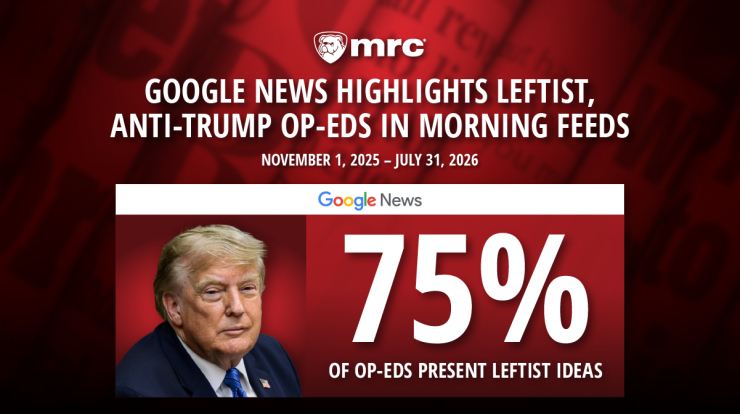
Around 80% of all reviewed stories during that period came from left-leaning sources. By contrast, a scant total of eight stories came from right-leaning sources (More about the right-leaning breakdown later in this piece). The 80% is even more tilted to the left than the 69% average for the Big Four News Apps coverage across all news topics during the same reviewed period.
Not only have the Big Four News Apps been biased in the sheer number of left-leaning stories that they have published, but they have also promoted stories that take a remarkably partisan stance against Trump and his candidates.
For example, Google published a May 20 article from The Guardian headlined, “Trump’s allies in danger of scraping false hope from Maga victory in Kentucky primary.” This piece compared Trump to a “cult leader” and claimed that he runs the GOP like a “mob boss.” The article also targets Republican voters’ support for Trump, claiming they are more “out of whack with the country at large.”
Other stories elevated by the Big Four News Apps similarly reinforce a narrative portraying Trump-backed victories as losses and his endorsements as toxic. Some even suggested Trump himself would lose the 2026 midterms to Democrats. Other headlines used loaded language and framing, including terms like “revenge,” “retribution” and “villain,” to characterize his role in primary races.
Some examples of headlines are below.
Apple News:
- “Trump's retribution? What to watch in Tuesday's elections in Indiana, Ohio and Michigan,” by The Associated Press, promoted May 5.
- “Trump promises 'bigger majorities' for GOP even as midterm warning signs flash for his party,” by The Associated Press, promoted March 26.
- “‘This is a very clear warning’: After Indiana, redistricting pressure mounts in the South,” by Politico, promoted May 7.
Google News:
- “Dems Stunningly Flip Seat in Major Humiliation for Trump,” by The Daily Beast, promoted March 13.
- “Trump's revenge politics comes back to haunt him,” by Axios, promoted on May 22.
- “Cassidy Loses His Primary in Louisiana, as Trump Vanquishes Another G.O.P. Foe,” by The New York Times, promoted on May 17.
- “Trump's revenge tour comes for Massie,” by Axios, promoted on May 19.
- “Accused Sexual Harasser GOP Candidate Steps Down, An Apparent Neo-Nazi Takes His Place,” by Rolling Stone, promoted on March 7.
Microsoft’s MSN:
- “Republicans break with Trump in California governor’s race,” by Politico, promoted April 13.
- “Trump gets revenge, and other takeaways from Tuesday’s Indiana and Ohio primaries,” by CNN, promoted May 6.
- “'Total disaster.' Trump eyes Kentucky's Thomas Massie in latest MAGA purge,” by USA Today, promoted May 18.
- “Trump's revenge spree stuns Senate Republicans,” by Axios, promoted May 20.
- “Democrat 'angered' & 'saddened' by Republican's primary loss,” by CNN, promoted May 20.
- “Trump got his revenge on 'disloyal' Republicans but it could cost him,” by The Independent, promoted on May 21.
Yahoo News:
- “Texas primary shows that MAGA loves a villain,” by Salon, promoted March 4.
- “Trump sent a message by targeting Bill Cassidy. In defeat, Cassidy delivered one back,” by CNN, promoted May 17.
- “Cassidy tried to get along with Trump after his impeachment vote. Retribution came anyway,” by The Associated Press, promoted May 18.
Alternatively, only eight stories, accounting for 5% of the total GOP primary election stories, originated from right-leaning outlets.
The Big Four News Apps’ systemic erasure of right-leaning outlets is shocking. The excluded outlets are likely better positioned to effectively inform GOP voters about issues that matter to them and Trump's agenda, the very agenda advocated by the man they elected to the White House two years ago.
This number is even inflated. The inflation stems from a late push with a couple of right-leaning stories in the final week of the 100 days. Still, the inclusion of the last-minute addition of right-leaning stories is not as laudable as it sounds, as they both conceded defeat for Spencer Pratt in the Los Angeles mayoral primary, rather than offering a different perspective on the other competitive races earlier in the cycle.
In several key races, right-leaning sources were completely shut out by Apple News, Google News, Microsoft’s MSN and Yahoo News, and instead, left-leaning sources were given a monopoly. Right-leaning outlets such as Just the News, Washington Examiner, The Federalist and The Washington Times did not get a single article advanced by the Big Four News Apps over the first 100 days of coverage, even though these publications posted stories on the same races.
Methodology: The Media Research Center tracked the top 20 stories promoted by Apple News, Google News, Microsoft’s MSN, and Yahoo News over a period of 100 days, from March 1 to June 8 at approximately 8:30 AM ET. The MRC specifically selected stories related to Republican or open primaries and used media bias firm AllSides to determine the ideological leaning of the sources. The first Republican primaries took place in Arkansas, North Carolina, and Texas on March 3, 2026. The last primaries included in this study were held on June 2 and involved California, Iowa, Montana, New Jersey, New Mexico and South Dakota.