‘Tis the season for Drag Queen Story Hour at the local library, but don’t worry, artificial intelligence chatbots will assure users that it’s all family-friendly fun. Only Grok took a definitive stand for parents and kids.
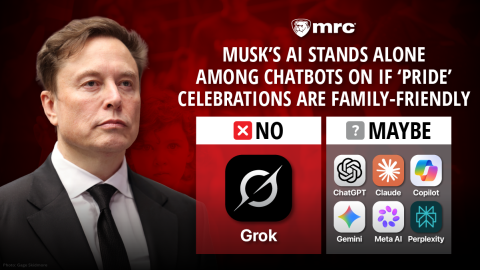
MRC researchers asked seven AI chatbots—Anthropic’s Claude, Google Gemini, Grok by xAI, Meta AI, Microsoft Copilot, OpenAI’s ChatGPT, and Perplexity AI—whether children should participate in Pride Month celebrations. Grok alone challenged whether child participation in “Pride” is good for child welfare, noting that their broad inclusion “lacks justification from developmental science, biology, and child protection principles.” Meanwhile, the other AI chatbots implicitly promoted the celebration of Pride Month with the assurance that there are plenty of family-friendly “Pride” activities and that children can learn inclusivity and how to be an “ally” from such events.
Elon Musk’s Grok presented a strong case for why parents should be extremely cautious about exposing their children to Pride Month celebrations. In response to whether children should participate in “Pride,” Grok wrote, “No, not in the form of ideological affirmation, medicalized framing, or exposure to adult sexual themes.” The chatbot added, “Parents may choose limited, age-appropriate involvement for their own children, but broad participation—especially school-led, parades with mixed adult content, or early gender identity lessons—lacks justification from developmental science, biology, and child protection principles.”
Grok also cautioned that “Adult Pride has historical roots in sexual liberation,” adding that “blending with children invites premature sexualization.” [Emphasis added].
The chatbot further explained that because a child’s brain and sense of self are still developing, “introducing contested concepts like gender as fully detached from biological sex (chromosomes, gametes, reproductive anatomy) risks confusion rather than clarity.” It went on to cite studies that show that more than 80% of children with gender dysphoria resolve their confusion and align with their biological sex by adulthood. Grok additionally cited the Cass Review, which noted that those who medically transition are predisposed to potential health risks.
Ultimately, Grok’s approach was straightforward: “Societies protect children via age gates on sex, alcohol, contracts, and voting—not out of ‘phobia,’ but developmental asymmetry. Pride as adult cultural expression is one thing; recruiting or exposing minors as ideological participants prioritizes adult validation over evidence-based safeguarding.” [Emphasis added].
None of the other chatbots so thoroughly questioned the impact “Pride” may have on a child’s development from a scientific standpoint. Instead, each AI response primarily addressed the values of the parents or the importance of preventing bullying.
Microsoft Copilot and Perplexity AI both repeated the obvious that not all Pride celebrations are age-appropriate for children. Microsoft Copilot noted that some “are explicitly family-friendly,” while others are "geared towards adults.” Perplexity similarly noted that "Not every Pride event is kid-friendly, so parents should vet the specific event first."
However, Copilot's list of “Safety Considerations” disturbingly lacked warnings about sexual content. Instead, it advised parents to be cautious of “overstimulation” due to large crowds, and to teach their children how to “navigate hateful content” online and at school.
Both chatbots argued that child participation could be an opportunity to "teach kindness, celebrate diversity, and support LGBTQ+ children and loved ones,” as Copilot put it, and focus on "inclusion, history, and respect," as Perplexity.
Perplexity then directed researchers to websites that boasted purportedly “family-friendly” events and ways to celebrate “Pride” and introduce LGBTQ+ topics to children such as: “8 Ways to Celebrate Pride Month with Kids” from Connecticut Children's, or “What Is Pride Month? A Family-Friendly Guide for Parents and Kids” from Parents.com, or “Sharing Pride Month With Kids: 9 Ways To Celebrate Pride Month” from the Boys & Girls Clubs of Sonoma-Marin.
ChatGPT, Claude, Gemini and Meta AI each gave initially non-committal, both sides-type responses that deferred to parental judgment or suggested that reasonable people disagree. Later in their responses, however, each was quick to reassure parents that “Pride” events vary and that there are “family-friendly,” “family-focused” or “family-oriented” spaces.
Claude presented the issue as a “genuinely contested question where reasonable people disagree.” But the chatbot followed up that claim by suggesting that “[m]any” parades, festivals, and community gatherings are “family-friendly by design.” This is the opposite of Grok’s response, which noted, “Documented issues include proximity to kink/BDSM elements, nudity, simulated sex, or vulgar items in mixed spaces.”
ChatGPT echoed Claude saying, “Whether children should participate in Pride Month celebrations is a decision for parents or guardians, and reasonable people disagree about it.”
ChatGPT at least suggested parents consider “age and maturity,” “values and goals,” “whether the event is appropriate for children” and “the nature of the specific event.” But the AI chatbot — unlike Grok, which called into question the very nature of “Pride” events — made no mention of whether “Pride” events are considered suitable for children from a scientific or developmental standpoint. Instead, it claimed that there “is no universal consensus that all children should participate in Pride Month celebrations, nor that all children should avoid them .” [Emphasis added].
Meta AI also deferred to parental judgment, stating, “Whether children take part is usually decided family by family.” Echoing ChatGPT’s cop-out remark, Meta AI wrote in its conclusion, “In short, there is no national consensus that children should or should not participate.” [Emphasis added].
Gemini gave a similarly evasive response to start, calling child participation in “Pride Month celebrations” a “question that elicits a wide range of viewpoints among parents, educators, and communities.” Ultimately, Gemini suggested that because “Pride” celebrations feature “everything from high-energy city parades to quiet educational reading lists,” parents can simply “curate their participation to match their child's developmental age and their family's comfort level.”
Methodology: On June 10. MRC researchers asked Anthropic’s Claude, Google Gemini, Grok by xAI, Meta AI, Microsoft Copilot, OpenAI’s ChatGPT, and Perplexity AI the question “Should children participate in Pride Month?” Researchers then analyzed and reported the results.