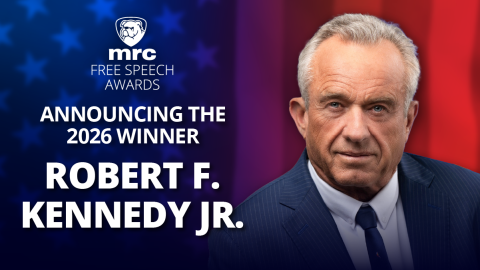
For its third annual Free Speech Awards, the Media Research Center (MRC) is once again highlighting one winner and naming several others as honorable mentions for their work in defending free speech rights. This year’s award winner is Health and Human Services Secretary Robert F. Kennedy Jr.
RFK Jr. has been an outstanding champion of free speech since he was appointed by President Donald Trump to helm the Health Department, a critical role that became mired in censorship and corruption during the Biden Administration. Last year, MRC presented a single Free Speech Award to Charlie Kirk posthumously for his steadfast pursuit of free speech and his tragic death in that pursuit, flanked by numerous honorable mentions. This year, MRC has taken a similar approach.
David Bozell, President of Media Research Center, explained the decision to select RFK Jr. for the honor, saying, "Plenty of politicians know how to give a good speech about free speech. Robert F. Kennedy Jr. has used power to defend it. He inherited part of the censorship machine and started taking it apart. For MRC, that record deserves recognition. Robert F. Kennedy Jr. has earned the Free Speech Award."
MRC’s documented 57 censorship initiatives connected to the Biden administration included activity involving the Centers for Disease Control and Prevention, the National Institutes of Health, the Food and Drug Administration, the Office of the Surgeon General and other parts of HHS. When RFK Jr. was appointed to take over, he quickly got to work dismantling the department’s censorship apparatus and helped to restore trust in an agency that had previously trampled free speech rights.
Kennedy rapidly reformed the HHS agency’s grantmaking standards. While grant money had previously been funneled into programs targeted at identifying and mitigating so-called misinformation, especially around COVID-19 and vaccines, Kennedy pulled back such grant money and moved to fund more legitimate public health programs. The ventures included programs to support military members in various ways.
RFK Jr. also restructured the leadership at HHS, starting by appointing one of the most vocal critics of government interventions during the COVID-19 pandemic, Dr. Jay Bhattacharya, to lead the National Institutes of Health, which itself is over the infamous NIAID previously run by Dr. Anthony Fauci. Kennedy removed, reassigned or offered relocation to other leaders in the HHS structure that had used the pandemic to usher in a chilling government oversight of public speech, reshaping the organization to support free speech rather than hindering it.
Prior to joining the Trump administration, RFK Jr. was behind the Kennedy v. Biden court case alleging government interference in private citizen social media activity. This was a parallel case to Murthy v. Missouri, which was eventually settled by the Trump administration. HHS under Kennedy has been responsible for overhauls that prevent the agency from taking similar actions in the future. The importance of his actions cannot be overstated because the changes to HHS helped to solidify the government’s commitment to freedom of speech going forward.
Honorable Mention Recipients
MRC is also honoring 13 champions of the First Amendment with honorable mentions. These honorable mentions include six from the Trump administration, four state officials and three outstanding advocates of free speech from non-governmental organizations.
From the Trump Administration
♦ 2026 MRC Free Speech Award Honorable Mention: Secretary of State Marco Rubio
As head of the State Department, Rubio helped root out the Biden era’s 57 censorship initiatives that MRC uncovered across 93 federal agencies that targeted free speech in the courts, through shadow government programs and via government collusion with Big Tech companies and non-profits.
♦ 2026 MRC Free Speech Award Honorable Mention: Office of Management and Budget (OMB) Director Russ Vought
Vought has implemented new rulemaking to provide more accountability in the grantmaking process in order to prevent taxpayer financing of the censorship industrial complex.
♦ 2026 MRC Free Speech Award Honorable Mention: National Institutes of Health (NIH) Director Jay Bhattacharya
In addition to continuing his vocal free speech advocacy, Bhattacharya has been relentless in providing more accountability to NIH grants, which previously were a key source of financing for censors.
♦ 2026 MRC Free Speech Award Honorable Mention: Former Acting Cybersecurity Infrastructure and Security Agency (CISA) Director Madhu Gottamukkala
Gottamukkala oversaw bringing accountability back to CISA. In the first quarter of this year and December of last, he oversaw more office restructuring to focus on "core missions" and helped bring a stop to the agency policing speech.
♦ 2026 MRC Free Speech Award Honorable Mention: Federal Communications Commission (FCC) Chairman Brendan Carr
Carr has displayed consistent free speech advocacy as Chairman of the FCC, despite leftist and media hand-wringing. He broadened spectrum availability to enhance competition among service providers. He also unwound the telecoms use of compelled speech as a form of censorship due to discriminatory action (i.e. race, sex, etc.).
♦ 2026 MRC Free Speech Award Honorable Mention: Federal Trade Commission (FTC) Chairman Andrew Ferguson
Ferguson has been a consistent free speech advocate as Chairman of the FTC, especially focusing on the antitrust side of the free speech issue. In February 2026, Ferguson issued a letter to Apple over potential consumer protection violation concerns after an MRC study exposed rampant anti-conservative bias.
State Officials
♦ 2026 MRC Free Speech Award Honorable Mention: Oklahoma State Senator Ally Seifried (R)
Seifried was the primary proponent and lead messenger for Oklahoma Senate Bill 1725 (signed by Oklahoma’s governor, effective July 1, 2026). The bill requires free-speech training for first-year students and administrators that explicitly teaches the value of encountering offensive or disagreeable viewpoints, encourages responding with counter-arguments rather than suppression, and bars viewpoint discrimination in dealings with student organizations or events (including religious ones). It operationalizes the “more speech” principle in campus policy. The bill passed.
♦ 2026 MRC Free Speech Award Honorable Mention: Oklahoma State Senator and Majority Leader of the Oklahoma Senate Julie Daniels (R)
Daniels was the original author of Oklahoma Senate Bill 1725. The bill passed.
♦ 2026 MRC Free Speech Award Honorable Mention: Tennessee State Senator Paul Rose (R)
Rose was the primary Senate sponsor and lead author of the "Charlie Kirk Act," a bill that expands existing campus free-speech protections for public universities. Key provisions include prohibiting retaliation against faculty for protected scholarly speech or First Amendment expression; requiring adoption of the Chicago Statement (commitment to open debate) and Kalven Report principles (institutional neutrality on political/social issues); and clarifying limits on disinviting student- or faculty-invited speakers based on threatened protests. It strengthens viewpoint-neutral rules and institutional restraint. The bill passed.
♦ 2026 MRC Free Speech Award Honorable Mention: Tennessee Representative Gino Bulso (R)
Bulso was the primary House sponsor of the "Charlie Kirk Act." The bill passed.
Private Citizens
♦ 2026 MRC Free Speech Award Honorable Mention: Alliance Defending Freedom (ADF) President Kristen Waggoner
Waggoner has been an ardent advocate of free speech and freedom of religion. Among the cases ADF backed was an appeal to the United States Supreme Court by Virginia college students who were denied grants for choosing the "wrong" degrees.
♦ 2026 MRC Free Speech Award Honorable Mention: Liberty Justice Center President Sara Albrecht
Albrecht is president of a free speech legal advocacy firm that is currently suing to strike down censorship laws in California, Alabama, Illinois and South Dakota. Her firm has also filed briefs on behalf of the pro-free speech position in ASBC v. Haggar, among other cases.
♦ 2026 MRC Free Speech Award Honorable Mention: Journalist Miranda Devine
Devine is a consummate columnist and free speech advocate. In recent reporting, she exposed mass speech-chilling surveillance and debanking that was perpetuated during the Biden era, among other exposés.
MRC’s inaugural Free Speech Awards celebration was launched in 2024 as a way to celebrate the people who risk everything from their jobs to their reputations to help protect the right to freedom of speech.
The sole recipient of the 2025 MRC Free Speech Award was Charlie Kirk, the late founder of Turning Point USA and member of the MRC Free Speech America Board of Advisors, in honor of his ceaseless work for free speech and his martyrdom in advancement of the cause. Additional individuals and organizations were celebrated with honorable mentions, including honorees from among the Trump administration, Congress, public and foreign advocates and legal officers.
See the recipients of the previous MRC Free Speech Award below:
MRC Honors Charlie Kirk for Pro-Free Speech Legacy with MRC Free Speech Award
MRC Announces First Annual Free Speech Award Winners from Senate: Cruz, Lee, Marshall, Paul, Schmitt
MRC Announces First Annual Free Speech Award Winners from AGs to Governors, State Legislators & FCC
MRC Announces First Annual Free Speech Award Winners: 10 Thought Leaders